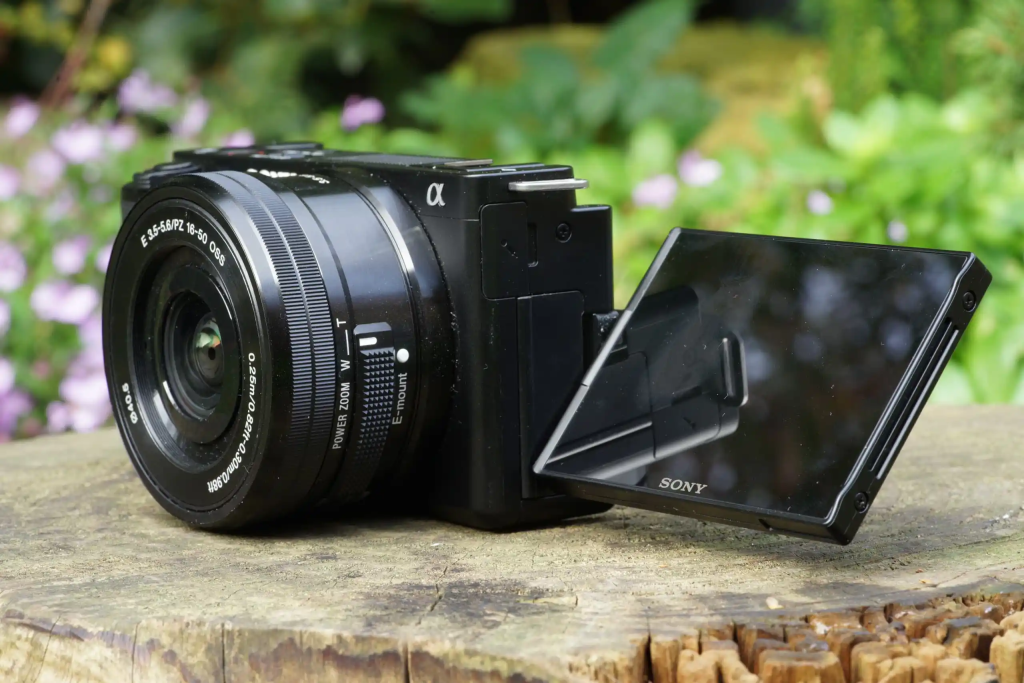
In spring 2020, Sony introduced the ZV-1, a fixed lens camera aimed at content creators and best camera for photography and video vloggers. The compact camera is built around a 1″-type sensor and 24-70mm-equivalent zoom lens. It offers many video-friendly features, but for those looking for higher-end video performance and the flexibility offered by an interchangeable lens design, the ZV1 doesn’t quite fit the bill. Enter Sony’s new ZV-E10.
The ZV-E10 is a new Alpha camera and is built upon the expansive E-mount system. The ZV-E10 includes a larger APS-C image sensor, promising shallower depth of field, better image and video quality and more versatility. The ZV-E10 also comes with the same great autofocus features as users have come to expect from Sony’s A6XXX series of cameras. At its core, the ZV-E10 aims to blend the vlogger-friendly design of the ZV1 with the high-quality performance and flexibility of a Sony A6100. Let’s take a closer look at Sony’s new camera and see what it promises to offer.
Sony ZV-E10 Key Features and Specs
24.2MP APS-C Exmor CMOS image sensor
BIONZ X processing engine
ISO range of 100-32,000 (expandable to 50-51,200)
Fast Hybrid AF, Real-Time Eye AF and Real-Time Tracking AF
Face Priority AE
Electronic image stabilization and stabilization data in file metadata
Natural Skin Tones and Soft Skin Effect
Digital Audio Interface via Multi-Interface shoe
Built-in directional 3-Capsule mic with supplied wind screen
Design and Usability
Ahead of the camera’s announcement, we were not given a great look at the ZV-E10 body itself. However, we have seen enough to know that it’s very similar in style to the A6100, although a bit more compact. Despite the larger sensor and the lens mount, the ZV-E10 is not much larger than the ZV1. Sony’s new vlogging camera is 115.2mm (4.53″) wide, 66.9mm (2.52″) tall and 59.4mm (1.76″) deep. For comparison, the ZV1 is 105.5mm x 60mm x 43.5mm, and the A6100 is 120mm x 66.9mm x 59.4mm. The ZV-E10 weighs 343 grams (body only), whereas the A6100 weighs 396g and the ZV1 and its built-in lens weigh 294g.
A big difference between the Sony ZV-E10 and the Sony A6100 is the display. While both have touchscreens, the ZV-E10’s display is vari-angle, meaning you can swivel it out to the side to see the entire display while photographing or recording yourself. This vlogger-friendly feature is a significant difference in terms of usability. You can also turn the camera on simply by opening the LCD, which is a neat feature. The ZV-E10 includes a recording lamp (visible on the front), a red frame around the LCD during recording, a zoom lever around the shutter release and an easy-to-hold front grip. The zoom lever can control attached Power Zoom “PZ” lenses and go through ClearView digital zoom (available from 1x to 2x).
The ZV-E10 includes many great still imaging functions, as well, but it is clearly aimed at video content creators, so its control layout is designed accordingly. The ZV-E10 has a large dedicated record button, including Background Defocus and Product Showcase buttons. These buttons set up the camera to give you a shallow depth of field in the case of the former button, and in with the latter, adjust settings for optimal performance when filming products/objects. For example, if you’re recording yourself showing off an item, you want the camera to focus on you when you’re speaking, but the item when you are holding it up to the camera. In the case of either button, you can, of course, set up the camera manually, using aperture priority or adjusting focus area and mode settings. Still, the buttons make it easier for those who may not want to adjust many settings.
Video and Imaging Features and Performance
The ZV-E10 has the same 24.2-megapixel APS-C Exmor image sensor as the Sony A6100 and A6600 cameras. To that end, it promises impressive image and video quality. The APS-C sensor has about three times the area of the 1″-type sensor in the ZV1 and ten times the area of a typical smartphone image sensor. A larger sensor means, all else equal, better image quality across a wider range of ISO settings and shallower depth of field at the same apertures. The ZV-E10’s native ISO range is 100-32,000, which can be extended to 50-51,200.
You also get access to the 64 E-mount lenses that Sony makes, plus third-party lenses, thanks to the ZV-E10’s lens mount, something the ZV-1 doesn’t offer. The larger image sensor and the flexibility of interchangeable lenses promise improved video creation and more cinematic results.
To help with cinematic results, the ZV-E10 promises lower noise, better color, improved color gradation and higher dynamic range than the ZV1. Plus, the new camera includes Sony’s popular Natural Skin Tone and Soft Skin Effect from the ZV1. The latter effect can be set to off, LO, MID and HI strengths.
The ZV-E10 also records in S-Gamut3.Cine/S-Log3, S-Gamut3/S-Log3 (something the A6100 does not offer), promising better flexibility during post-processing for those who desire more control. The camera aims to provide great results straight-out-of-camera for those who want to keep things simple without sacrificing the flexibility for users who want to edit their videos.
Speaking of video, the ZV-E10 records 4K UHD video at 24p and 30p framerates and can record HLG video. 4K video is recorded with the full width of the APS-C sensor and includes 6K oversampling. At Full HD, the camera can record at up to 120p and includes Slow & Quick video functionality, meaning you can record as slow as 1fps or as fast as 120fps for slow- and fast-motion video. S&Q is available directly via a mode button on the camera, which cycles through still/movie/S&Q modes.
 Site Title
Leave a comment